

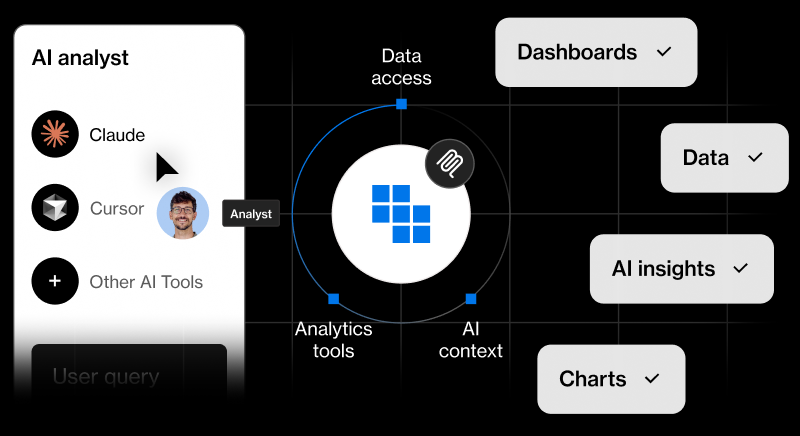
Digital analytics is having a reckoning as AI changes the way people interact with and learn from data. Kubit’s MCP server bridges the gap between the data safe and sound in your cloud data warehouse and the LLMs used more and more day to explore business insights.
First things first: what is warehouse-native analytics?
Before you can get started with Kubit’s MCP server, you need to understand the difference between legacy data analytics and Kubit’s warehouse-native platform.
In legacy analytics architecture, your customer and business data is spread out and siloed across many different tools. The stack relies on brittle connections to normalize and manage data, but the cost is high – you pay a heavy “data tax” for constant reprocessing, duplication, and ETL pipelines while having little control over where data is stored or how it’s accessed.
In warehouse-native architecture, things are simpler. Your data is stored in a centralized cloud data warehouse, with all analysis running directly on top of it. Instead of relying on SDKs, ETLs, and error-prone workflows, warehouse-native platforms query governed data in warehouses like Snowflake, Databricks, BigQuery, or Clickhouse in real time – less overhead, no data drift, and an AI-ready setup you can safely use with an MCP server.
What is model context protocol (MCP)?
MCP is an open standard that defines how large language models securely interact with tools, data, and business logic. Instead of letting AI operate on copied data or loosely defined APIs, MCP creates a governed way for AI to retrieve context, respect access controls, and use the same definitions your business already relies on.
This new protocol makes it possible to use AI tools like Claude or Cursor to access governed data from your own trusted source of truth, your cloud data warehouse.
Why is using AI without an MCP server dangerous?
AI is being used everywhere, often without the express permissions of company leadership. When a user asks business-specific questions of a tool like ChatGPT or via an agent in another SaaS tool, you can’t control the interaction – or the output.
Without a layer of logic and governance built specifically for your business and metrics, these tools are just guessing (or hallucinating) their responses. They’re also not considering privacy and IP, giving any AI agent free reign to explore across PII, customer information, and in-depth product details.
An MCP server is the translation and protective layer that helps agents understand your unique definitions, access rules, and relationships so everyone can make decisions based on accurate, fully governed AI insights.
Kubit: warehouse-native digital analytics meets MCP
Once you’re running digital analytics on Kubit’s warehouse-native platform, you can use the MCP server to access insights from any AI tool that supports the protocol. Anyone can log into a generalized LLM like Claude, for example and explore customer, product, and operational insights through a layer of governance you control.
The result is AI-powered analytics you can actually trust. When an AI asks “Why did conversion drop?” or “Which users are most at risk of churn?”, MCP ensures the answer is grounded in your real metrics, logic, and permissions. As AI becomes a primary interface for insights, MCP is what turns digital analytics into a safe, scalable, AI-ready system.

The 4 Pillars of Kubit’s MCP Server
1. Flexibility: analytics where you work
Your data team uses SQL. Your PM lives in Notion. Your engineers code in Cursor. Why force everyone into the same analytics UI?
Kubit’s MCP server delivers warehouse-native insights in the tools your teams already use. It’s self-service analytics that actually serves users—on their terms.
Use cases:
- Marketing exploring campaign performance in Claude
- Product managers exploring cohort behavior in Claude while drafting PRDs
- Engineers debugging funnel drop-off in Cursor during code reviews
- Customer success teams pulling retention data in ChatGPT to inform outreach strategies
2. Governance: trust at scale
MCP doesn’t bypass your security model, it enforces it. Every query abides by your permissions and semantic controls.
Each query respects:
- RBAC permissions (users only see data they’re authorized to access)
- Semantic definitions (metrics like “active user” mean the same thing everywhere)
Your governance travels with your data. No exceptions.
3. Accuracy: semantic layer as a guardrail
All queries are constructed by Kubit’s semantic layer before they hit your warehouse, applying the right business logic every time.
Without structure, AI might:
- Confuse “sessions” with “events”
- Miss critical joins between tables
- Apply the wrong time windows to cohort analysis
- Ignore test data filters
With Kubit, business rules, dimension hierarchies, and metric calculations are pre-defined and consistently applied. They’re also configurable – if you make a change, it applies across your entire system.
4. Scale: warehouse-native performance
Because Kubit connects directly to your cloud data warehouse (Snowflake, BigQuery, Clickhouse, Databricks), there’s no data duplication, no ETL lag, and no storage overhead.
MCP queries leverage your existing compute resources and benefit from:
- Fresh data (real-time access to warehouse tables)
- Query optimization (Kubit translates natural language into efficient SQL)
- Cost control (warehouse-native architecture minimizes unnecessary scans)
As your data grows, Kubit scales with it – without asking you to rearchitect your stack.
The future of analytics is agentic
Your teams shouldn’t have to choose between powerful AI tools and trustworthy analytics. With Kubit’s MCP server, they get both.
Start exploring customer insights in the workflows that matter most.